• Skip to main content
  • Skip to header left navigation
  • Skip to site footer
  • Home
  • About
  • Movies
  • Musical
  • Television
Pop Culture Blog: Music, Movie and Humor

Pop Culture Blog: Music, Movie and Humor

Leveraging low-hanging synergies outside the vertical fruit box since 1999.

Guru Is Gone: The 5 Best Gang Starr Songs

by admin on August 14, 2026
in Musical

Author’s Note: I originally wrote this piece in April 2010, just days after we lost Keith Elam, better known to the world as Guru. At the time, listing out my favorite tracks was a way to process the loss of an absolute giant. Years later, these beats and rhymes haven’t aged a day. What follows is an updated look at that original list – and why Gang Starr’s catalog should remain mandatory listening. – Updated on 8/14/2026

The best Gang Starr songs bring Guru’s steady, unsentimental delivery together with DJ Premier’s snappy drums, samples, and supernatural instinct for finding memorable loops. My personal five faves are “Take It Personal,” “Who’s Gonna Take the Weight?,” “DWYCK,” “Words I Manifest,” and “Mass Appeal.” But those five are just the first rounds of a a full clip. DavePye.com looks at why Gang Starr’s mass appeal still knocks louder than a trunk full of Cerwin-Vegas.

Why Gang Starr Stood Out Early

By the time No More Mr. Nice Guy dropped in 1989, the genre had started to gain remarkable momentum for such a young sound. As a result of the additional “competition”, we became used to rappers coming at us from all angles with a myriad of styles, questionable fashion and hair style choices and other creative differentiators.

The playful peacenik absurdity of De La Soul, the clown-prince energy of Biz Markie, the booming Kangol funk of EPMD, the bohemian vibe of A Tribe Called Quest and Flava Flav’s obsession with clocks, to name only a few examples.

And then there was Gang Starr.

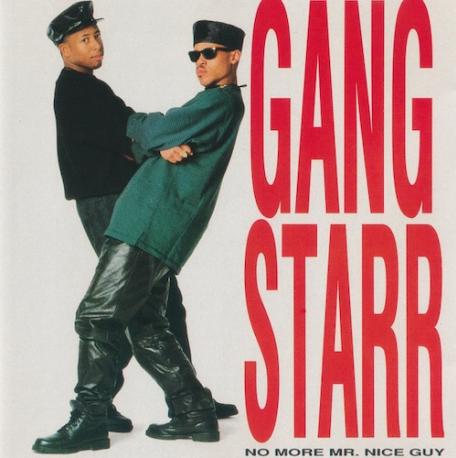
While their first album cover shows both members wearing matching hats some might describe as “afrocentric”, that’s where any thematic pageantry began and ended. Like a single flash in that photo studio. Why? because they didn’t need any of all that. For them, respect and recognition was never hard to earn (see what I did there?)

Guru stood out through the quiet, icy weight of his composure. That composure was not a lack of technique or personality. Guru could be severe, amused, argumentative, or quietly dismissive, often without changing the temperature of his voice. He did not need a frantic flow to establish authority.

That rare kind of effortless gravitas reminds me of that Goodfellas line, “Paulie may have moved slow, but it was only because Paulie didn’t have to move for anybody.”

DJ Premier was (and still is) in a league of his own as a producer. He gifted Guru the appropriate soundscape: hard drums, brief musical phrases, scratches used as punctuation, and enough open space for a line to land. The pair made records that sounded planned without feeling overworked. Masterfully constructed and grittily primitive at the same time.

That Unmistakable Preemo Sound

DJ Premier was (and still is) in a league of his own as a producer. He gifted Guru the appropriate soundscape: hard drums, brief musical phrases, scratches used as punctuation, and enough open space for a line to land. The pair made records that sounded planned without feeling overworked. Masterfully constructed and grittily primitive at the same time.

I don’t have an ocean of data to support this claim, but I doubt there were many people – upon hearing the legendary triple bass drum thumps of Take it Personal for the first time – who didn’t drop everything to ask, “Who the fuck is this?” like Biggie at the beginning of Warning. I’d already grown very fond of Words I Manifest by 1992, but their sound evolved dramatically between the first 2 albums and I definitely uttered those very words myself. But we’ll get to that.

Premier’s best beats rarely try to impress you with how much layered material they contain. None of them do, really. If anything, they are magically sparse. A drum pattern with a little snap. A scratch dropped exactly where it belongs. Then enough empty space for Guru, Nas, Jeru, or whoever else happens to be holding the mic to find the rhythm inside a sentence.

That restraint is part of the trick. Plenty of producers can find a great sample. Far fewer know what to leave out. Fewer still can hear something that barely sounds musical and recognize it’s aural potential.

Think of Jeru the Damaja’s Come Clean, where those strange, hollow percussion tones are chopped and pitched until they sound like water droplets forming a melody. Premier finds sounds that don’t register as potential instrument replacements then makes them the centerpiece of a track. Or take Nas’s Nas Is Like, with its eerie, birdlike chirps turned into one of the most recognizable ideas in Premier’s catalog. On Gang Starr’s The ? Remainz, the crackle and static from a water-damaged record become part of the beat itself.

That is Premier’s innate instinct: not just finding the loop, but hearing music in something that barely sounds musical. It’s not something you can learn in school – or anywhere else. Sometimes he is sampling sound rather than music. A drip becomes a melody. A chirp becomes a hook. Static becomes atmosphere. He takes something most producers would hear as noise and makes it feel almost… inevitable? Let’s go with that. Magic should be hard to explain.

On This Page

  1. Why Gang Starr Sounded Different
  2. The Five Best Gang Starr Songs
  3. Why These Five Made the Cut
  4. The Songs I Left Out
  5. Gang Starr FAQs
  6. One More Word for Guru

The Five Best Gang Starr Songs

5. “Take It Personal”

I first heard “Take It Personal” at Vermont Academy in 1992. Jamal, a student from Brooklyn, got Daily Operation on cassette on the day it came out and played it constantly for the next few days. By the end of that run, the song had done what a great record does: it had stopped sounding like a new release and started sounding unavoidable.

The piano figure is simple, yet Premier gives it an unfriendly edge by leaving it exposed between the drums. Nothing in the arrangement asks for admiration. Guru does not make a theatrical case for taking offence; he sounds as if he has already decided that the matter is settled. That restraint keeps the song from becoming a routine threat record. It is direct, cold, and compact, with no wasted effort spent making the point seem larger than it is.

The early 1990s produced enough good rap to make any list of the period look arbitrary, a fact that shows up in my forgotten 1990s hip-hop list. “Take It Personal” keeps its place here for a simpler reason. It was an entry point, then it proved durable enough to survive familiarity.

4. “Who’s Gonna Take the Weight?”

The opening whistle on “Who’s Gonna Take the Weight?” should be irritating. Premier repeats it until it stops sounding like an interruption and becomes the source of the record’s tension. The drums do not soothe that tension. They tighten it. By the time Guru enters, the beat has made its terms plain: this is not going to drift past in the background.

Guru meets that pressure with an argument rather than a performance of anger. His delivery has force, but he does not confuse volume with conviction. The song deals with responsibility and social pressure without turning into a lecture, then leaves enough sharp edges in the rhymes to keep the message from becoming dutiful. The result is blunt without being clumsy. It sounds like a record built to make the listener pay attention, not congratulate it for having a serious subject.

The track could have collapsed under its own seriousness. Instead, it stays alert. Premier keeps the beat spare enough that every new sound changes the mood, and Guru keeps the subject moving by returning to the challenge in the title. He is not offering a sermon or a slogan. He is asking who is prepared to carry the burden after the talk has ended. That gives the record a tension that has lasted better than plenty of well-meaning rap songs from the same period.

3. “DWYCK”

“DWYCK” gives the list some needed release. Guru, Greg Nice, and Smooth B treat the record as an opportunity to outdo one another, yet nobody turns it into a tedious demonstration of skill. The beat has bounce, the verses have room, and the whole track carries the pleasure of three seasoned MCs trading ideas without trying to manufacture chemistry. It is a party record made by people who knew the party had to have a beat worth returning to.

Its path onto an album was almost accidental. In a 2019 interview with Billboard, Premier said “DWYCK” began as the B-side to “Take It Personal.” Nice & Smooth were returning a favour after Gang Starr let them use the “Manifest” instrumental, and the label passed on adding the track to Daily Operation. Premier later put it on Hard to Earn. Good decision. A song this loose and complete should not have remained a collector’s item.

Plenty of guest-heavy rap songs become a queue of people waiting for their turn. “DWYCK” feels more social than that. The MCs hear one another, take cues from the beat, and keep the exchange moving. It is a small distinction, but it is the difference between a collaboration that sounds booked and one that sounds like it had to happen. Gang Starr’s tougher records get more attention in serious criticism. This one reminds you that Premier and Guru knew how to enjoy themselves.

2. “Words I Manifest”

“Words I Manifest” comes from a Gang Starr that had not yet settled into the exact shape most people remember. The drums are less polished, Guru pushes his delivery harder, and the partnership has more roughness around the edges. None of that counts against it. You can hear the duo testing the balance that later records would make sound natural: a beat with a jazz-minded texture, an MC who refuses to rush, and a mood that does not need a crowded arrangement.

The full title matters. “Words I Manifest” is not the finished Gang Starr sound, and that is why it earns this spot. It catches Guru and Premier before their habits became signatures. Early work is often praised for being promising, which can be a polite way of saying it is not ready. This record is ready enough. Its imperfections are part of the case.

1. “Mass Appeal”

“Mass Appeal” is my favourite Gang Starr song. It makes polish sound suspicious. Premier’s musical phrase is graceful, the drums are clean, and Guru rides the arrangement with enough distance to keep it from becoming easy listening. The record feels accessible without asking permission to be liked. That balance is difficult to pull off, particularly in a genre where too much smoothness can drain the personality from a track.

The joke behind the song helps explain its appeal. Premier has said that he and Guru were making fun of radio’s habit of flattening hip-hop into something bland and safe, an approach that gave “Mass Appeal” its elevator-music idea. Then the parody became one of Gang Starr’s biggest hits. There is no contradiction to solve. The song works on its own terms: the hook is memorable, the beat is immaculate, and Guru never lets the record forget that it is mocking a system built to make everything harmless.

That is why it sits at No. 1. “Mass Appeal” sounds as good on a first listen as it does after you know every turn. It has enough craft to reward close attention and enough confidence to avoid demanding it.

The song gets cited so often that it can become a shorthand answer, which is a dull fate for a record this carefully made. Put it beside “Take It Personal,” and the contrast is useful. Both tracks have hard drums and Guru at the centre, yet one presses the listener into a corner and the other slips into the room with a polished smile. Gang Starr could do both. The difference is part of what makes the catalogue hard to reduce to one mood.

Why These Five Made the Cut

These tracks cover the part of Gang Starr’s run that matters most to me: an early version of the formula, the pressure of Step in the Arena, the precision of Daily Operation, the fun of a great collaboration, and a hit record that arrived with a smirk. The ranking does not try to give every album equal representation. It gives the five songs their proper order in my memory.

RankSongAlbumYearWhy It Made My Five
5“Take It Personal”Daily Operation1992The personal entry point, with piano and drums that never lose their bite.
4“Who’s Gonna Take the Weight?”Step in the Arena1991The whistle, the tension, and Guru’s refusal to overplay the message.
3“DWYCK”Hard to Earn1994Three MCs having more fun than most rap records permit.
2“Words I Manifest”No More Mr. Nice Guy1989An early, rougher version of the sound that would soon become unmistakable.
1“Mass Appeal”Hard to Earn1994A radio joke that became a near-perfect rap single.

The Songs I Left Out

“Moment of Truth” belongs in any serious conversation about Gang Starr, and “Above the Clouds” has a guest verse that could make a sensible person rebuild the whole list. “Work,” “Full Clip,” “Code of the Streets,” and “Just to Get a Rep” each have supporters with cases worth hearing. A ranking made by a room full of fans would likely push two or three of those tracks above “Words I Manifest.” Fair enough.

I am not trying to create the only Gang Starr starter list, and I would not hand this exact five to a listener who wanted the broadest possible introduction. “Mass Appeal,” “Moment of Truth,” and “Above the Clouds” would be difficult to leave out of that conversation. This is a different exercise: the records that kept pulling me back. My older post about rap is enough evidence that I am capable of turning nostalgia into a bad argument, so I have tried to keep that temptation in view. These five still hold up for me.

Gang Starr FAQs

1. What Is Gang Starr’s Most Famous Song?

“Mass Appeal” is the answer most listeners would give. It was one of Gang Starr’s biggest hits and remains the most direct place to start for someone who knows the group’s name but not its catalogue.

2. What Is Gang Starr Known For?

Gang Starr is known for the pairing of Guru’s measured, deep voice with DJ Premier’s sample-based production. Their records could hold jazz, funk, battle rhymes, street detail, humour, and social commentary without becoming crowded.

3. Was “Mass Appeal” Really Made as a Joke?

Yes. Premier has described “Mass Appeal” as a response to radio-friendly hip-hop that he thought had become too bland. The joke worked too well: the song became one of Gang Starr’s defining records.

4. What Happened to Guru?

Guru, born Keith Elam, died in New York on April 19, 2010, aged 48, after a battle with cancer. He left behind a catalogue that has not needed a sentimental rewrite to keep its force.

One More Word for Guru

Guru’s place in hip-hop does not depend on a memorial speech from me. Put on “Mass Appeal,” then “Take It Personal,” then the Gang Starr song you think I was foolish to leave out. The records can carry the rest of the argument.

{ 6 Comments }

Stan Rogers: The Voice, The Fire and The Legend of Flight 797

by admin on August 1, 2026
in Musical, Canadiana

Stan Rogers was a Canadian folk musician whose booming baritone and storytelling prowess defined maritime music for a generation. Known for classics like “Barrett’s Privateers” and “Northwest Passage,” Rogers died tragically at age 33 in the fire aboard Air Canada Flight 797. DavePye.com explores his enduring legacy, the enduring mystery surrounding his final moments, and why a man who never achieved widespread radio airplay during his lifetime remains a towering figure in Canadian history.

The Legend and Lore

  • The Man With The Booming Voice
  • A Catalog Built on Saltwater and Sweat
  • The Tragedy of Air Canada Flight 797
  • The Legend of Saint Stan
  • The Walk of Fame Petition
  • Stan Rogers FAQ
    • The Final Chord

    The Man With The Booming Voice

    If you grew up in Canada, you probably know the chorus to “Barrett’s Privateers” even if you have no idea who wrote it. You just absorb it through the cultural groundwater… like a Kokanee.

    It’s the kind of song that gets sung in pubs at 1:00 AM by people who have never set foot on a ship. I’ve heard it belted out by software developers who’ve never been closer to the ocean than a screensaver.

    Stan Rogers Death

    That was the gift of Stan Rogers. Born in Hamilton, Ontario, in 1949, Rogers spent his childhood summers visiting family in Canso, Nova Scotia. And those summers soaked into his bones. He absorbed the maritime culture, the country music his uncles played, and the rhythm of working-class life. By the time he started recording in the 1970s, he had developed a voice that sounded like it had been carved out of granite. Six foot four. A custom-built 12-string guitar. A rich baritone that demanded attention.

    He wrote folk songs about fishermen, farmers – people trying to hold their lives together in harsh conditions. And he did it better than almost anyone else. Which is, frankly, why commercial radio mostly ignored him while he was alive. He never crossed over with a Sundown or Big Yello Taxi, and I believe he was a-ok with that.

    A Catalog Built on Saltwater and Sweat

    Rogers only released four albums during his lifetime. Fogarty’s Cove in 1976 established his maritime bona fides. Turnaround in 1977 showed his growth as a songwriter. Between the Breaks… Live! in 1979 captured the raw energy of his stage presence and introduced “The Mary Ellen Carter,” an anthem about raising a sunken ship that became a metaphor for resilience itself [2]. Most bands today would kill for a four-album run that tight.

    His final album, Northwest Passage (1981), is likely his masterpiece, and the title track is often referred to as Canada’s unofficial national anthem. In 2005, CBC Radio ranked it the fourth greatest Canadian song of all time. It’s a sprawling, ambitious piece of music that connects the historical search for the Northwest Passage to a modern journey across the prairies. I wrote about “Barrett’s Privateers” in a Wednesday Wadio post years ago, and to this very day I listen to it more than any other Stan song, but “Northwest Passage” is the one that makes you want to pack up your life and drive west.

    The following clip is from the 1989 documentary, One Warm Line. Rogers and his pals are seen rocking a kitchen table in Nova Scotia like the Ramones of folk music. So good. It’s the Stan-related video I always use when introducing him to the uninitiated, and keep coming back to myself.

    He was on the verge of something bigger. Filling large halls on the East Coast. Headlining folk festivals across North America. The crossover success that eludes almost all folk artists seemed to be right in front of him.

    Then came June 2, 1983.

    The Tragedy of Air Canada Flight 797

    Rogers had just finished a performance at the Kerrville Folk Festival in Texas. He boarded Air Canada Flight 797 in Dallas, bound for Toronto and Montreal.

    About halfway through the flight, an electrical fire broke out in the rear lavatory. The crew attempted to fight it, but the smoke quickly filled the cabin, melting the ceiling and knocking out the cockpit instruments. The pilots managed a miraculous emergency landing at the Greater Cincinnati Airport in Hebron, Kentucky.

    The plane landed. The doors opened. Eighteen passengers and the five crew members escaped. But ninety seconds into the evacuation, the sudden influx of fresh oxygen caused a flash fire. The interior of the plane was instantly engulfed in flames.

    Twenty-three passengers died that day. Stan Rogers was one of them. He was 33 years old.

    Stan Rogers Canadian Folk Hero

    The Legend of Saint Stan

    Almost immediately after the crash, stories began to circulate. The rumors said that Rogers had used his massive frame to push people out the emergency exits. That he had carried women to safety, one under each arm, before diving back into the inferno to save more. That his booming voice had guided people through the smoke. Some accounts even claimed his final words were “Let me help you“. It’s a beautiful story. It’s exactly what you want to believe about a guy who wrote songs like “The Mary Ellen Carter.”

    The truth is harder to pin down, and the mystery only adds to the lore. The National Transportation Safety Board (NTSB) conducted a massive investigation into Flight 797. They interviewed every single survivor.

    There is no firsthand, verified account in the official record of Rogers saving anyone. The tragic reality of smoke inhalation is that he most likely succumbed before the doors were even opened. Which is a hard pill to swallow if you’ve spent years believing the myth.

    This begs the question: Do we care? True or not, I think the story has survived because everyone knows it’s what Stan would have done, if able. True or not, the fact that people wanted to believe it tells you everything you need to know about who he was. We don’t invent heroic death narratives for people we don’t respect. But, again, I’m not claiming anything was invented. We just don’t know. And never will.

    His biographer, Chris Gudgeon, documented how the legend grew. “From the ashes of flight 797, a new figure emerged: Saint Stan. He was an extension of Rogers’ Maritime Stan persona, only rougher and saltier still, with a heart of gold, a golden voice, and not a spot on him”. His brother Garnet called it the “Elvisization” of Stan. It’s a perfect description of what happens when a culture isn’t ready to let go of an icon.

    But neither man was there on the tarmac in Kentucky, eh?

    Enough about the myth. We don’t need the myth to honor the man. The legend persists because it feels true to the spirit of the music he left behind. Sometimes the stories we tell about a person are more important than the literal facts of their final moments.

    The Walk of Fame Petition

    Way back in 2009, I wrote a post about a petition to get Stan Rogers a posthumous star on Canada’s Walk of Fame. I couldn’t believe it was even a debate. He was a national treasure who deserved recognition long before some of the names that had already been honored. Brendan Fraser got a star in 2006. Celine Dion in 1999. Stan Rogers was still waiting.

    He never got the star. But in 2019, he was finally inducted into the Canadian Songwriters Hall of Fame. It was long overdue recognition for a man who articulated the Canadian experience with more depth and empathy than almost anyone else. It’s not a star on the sidewalk, but it’s something. And if we were to ask Stan, he’d probably prefer it. That man could write a song.

    Stan Rogers FAQ

    What happened to Stan Rogers?

    Stan Rogers died on June 2, 1983, in a fire aboard Air Canada Flight 797. The plane made an emergency landing in Hebron, Kentucky, due to an in-flight electrical fire. Rogers, along with 22 other passengers, died of smoke inhalation.


    Did Stan Rogers save people in the plane crash?

    Following the crash, rumors circulated that Rogers heroically saved other passengers by carrying them out of the burning plane. However, NTSB investigations and survivor interviews provided no verified accounts of this. The stories are generally considered folklore that grew out of grief and admiration for his larger-than-life persona.


    What was Stan Rogers’ most famous song?

    “Northwest Passage” is widely considered his masterpiece and is often referred to as Canada’s unofficial national anthem. “Barrett’s Privateers” is also incredibly famous, known as a staple singalong in pubs across the country.


    Who did Stan Rogers marry?

    Stan Rogers married Ariel Rogers in 1977.


    What are some interesting facts about Stan Rogers?

    Rogers was 6’4″ and played a custom-built 12-string guitar. Despite his strong association with maritime music, he was actually born in Hamilton, Ontario. His death on Air Canada Flight 797 indirectly led to major aviation safety improvements, including mandatory smoke detectors in airplane lavatories and floor-level lighting strips.

    The Final Chord

    Stan Rogers left behind a body of work that feels permanent. His songs don’t sound like they were written in the 1970s; they sound like they were pulled out of the Atlantic Ocean a hundred years ago.

    The tragedy of his death at 33 is the music we never got to hear. The triumph is that the music we did get will never be forgotten – made obvious by the fact new generations of Canadians are enjoying his work 43 years after he sailed into the horizon.

    He sang about broken men on Halifax piers and ships lost to the ice, and he made you feel every freezing drop of water. That’s a legacy that doesn’t need a myth to prop it up. Godspeed, Stan.

    { 0 Comments }

    Elliot Page in Trailer Park Boys: A Cameo For The Ages

    by admin on July 1, 2026
    in Television, Canadiana

    Elliot Page played Treena Lahey in Season 2 of Trailer Park Boys, a 2002 cameo that remains one of the best pieces of forgotten or flat out unknown Canadian pop culture trivia. Before their Oscar-nominated role in Juno or starring in The Umbrella Academy, the Halifax-born actor spent a summer in Sunnyvale Trailer Park befriending Ricky and defying Mr. Lahey. DavePye.com breaks down the exact episodes Page appeared in, why the character of Treena mattered to the show’s early dynamic, and how a future Hollywood A-lister ended up buying pepperoni for the boys in the park.

    Table of Contents

    • The Sunnyvale Summer of 2002
    • Who Was Treena Lahey?
    • The Ricky Connection
    • Why Treena Never Returned
    • From Sunnyvale to the Academy Awards
    • Elliot Page Trailer Park Boys – FAQ
      • A Long Way From Sunnyvale

      The Sunnyvale Summer of 2002

      It happens every time someone posts a screenshot from the early days of the show. Someone squints at the background, looks closer at the kid hanging around Ricky, and has a genuine “wait, WHAT?” moment. Yes, that is exactly who you think it is.

      Way before Inception had him folding cities in his sleep or The Umbrella Academy handed him a dysfunctional superhero family to wrangle, Elliot Page was doing something quieter – spending a summer in Sunnyvale Trailer Park. Credited then as Ellen Page, the Halifax-born actor showed up for five episodes of Season 2, which hit screens in 2002. Fourteen, maybe fifteen at the time of filming, Page carried this strange, almost bone-dry authenticity into a show that was still working out how deeply unhinged it actually wanted to go.

      Most people don’t realize this. Even hardcore fans sometimes forget. I posted about it on Facebook recently, and the sheer volume of comments from people who had their minds blown was staggering. It’s one of the best pieces of Canadian pop culture trivia out there. A future Oscar nominee, born and raised in Nova Scotia, cutting their teeth on the most quintessentially Nova Scotian television export in history. So a longer-form blog post had to follow.

      Who Was Treena Lahey?

      Page played Treena “T” Lahey, the daughter of Trailer Park Supervisor Jim Lahey and his estranged wife, Barb. The setup was simple: Treena didn’t actually live in the park. She visited her father during the summer, dropping into the chaos of Sunnyvale.

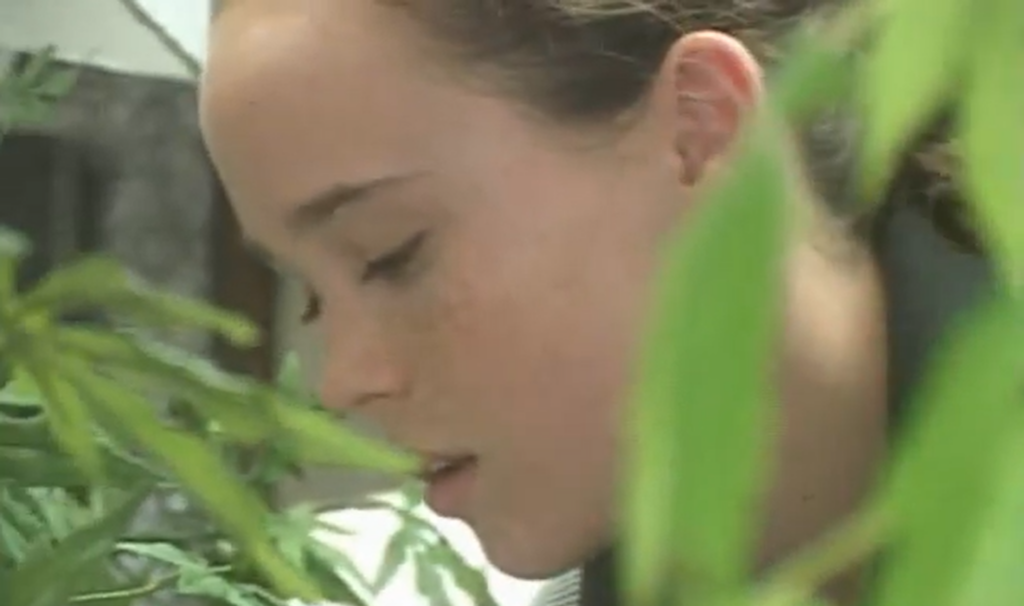
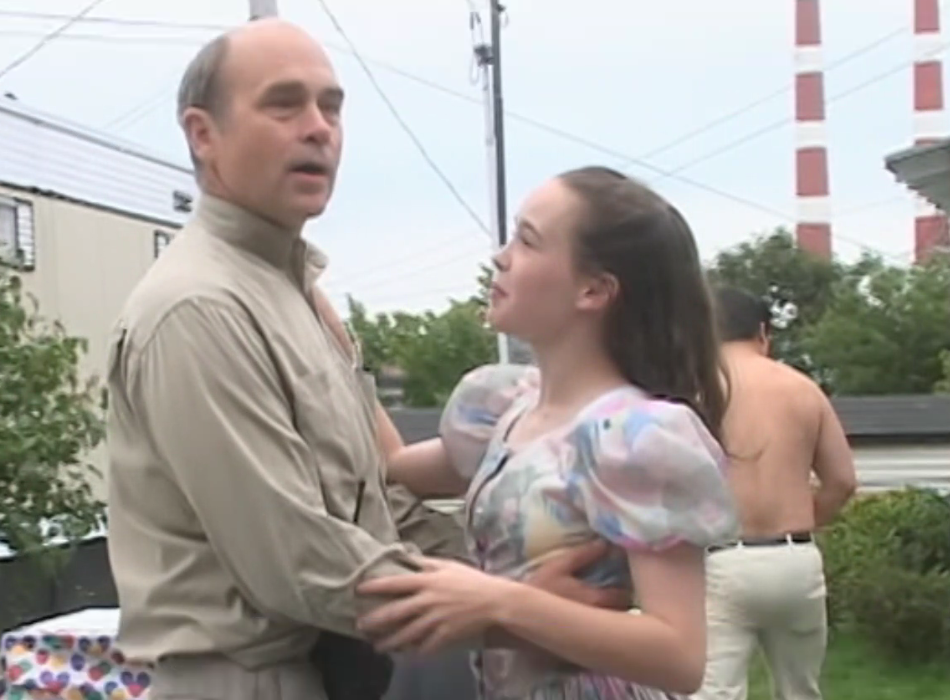
      Elliot Page as Treena Lahey in Trailer Park Boys Season 2, 2002

      Barb allowed the visit hoping it would help Jim get his life together. If you’ve seen the show, you know how well that worked out.

      What made Treena interesting wasn’t just the novelty of seeing a future star in baggy 2002 clothes. It was how the character functioned in the park. She was an outsider who didn’t judge the residents. Jim Lahey explicitly ordered her to stay away from Ricky and Julian, which guaranteed she would immediately start hanging out with them.

      The Ricky Connection

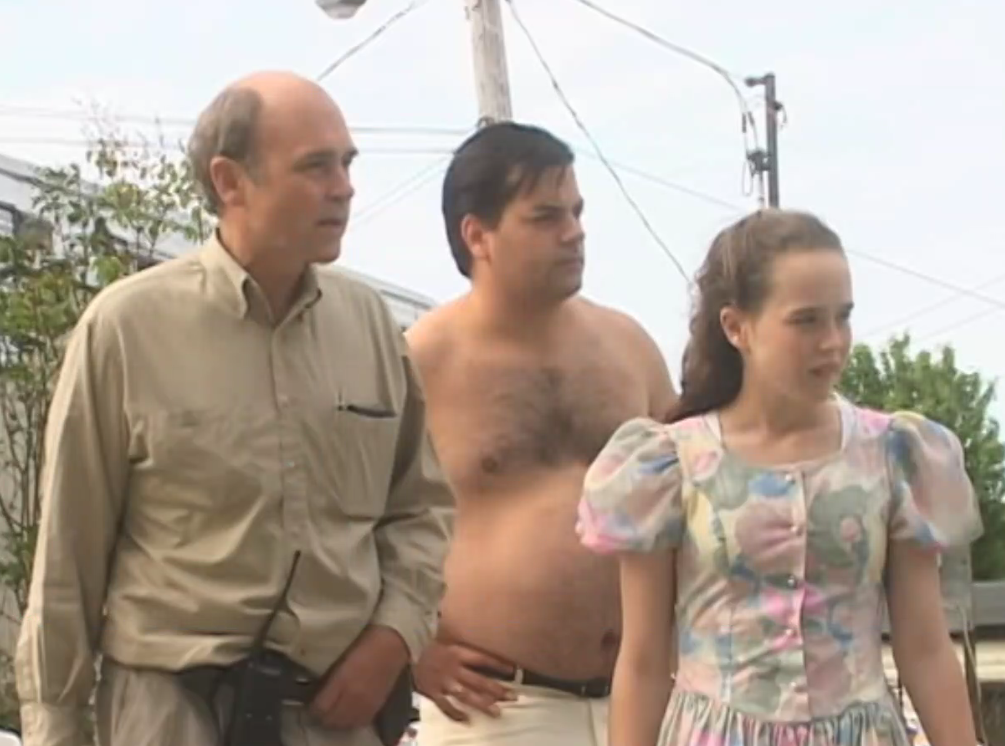
      Elliot Page as Treena Lahey with Jim Lahey and Randy in Trailer Park Boys Season 2

      The heart of Treena’s arc was her friendship with Ricky. It’s a dynamic the show didn’t explore often – Ricky acting as a bizarre, misguided mentor figure to someone else’s kid.

      Treena saw the better side of Ricky. She bought him chicken chips and pepperoni after he fixed her bike, picked him up a shirt when he had none, and actually sat down with him about his Grade 10 classes, telling him he was smarter than he thought. For a show that runs on chaos and bad decisions, that’s a genuinely tender thing to watch, though the show mostly treats it as a footnote rather than a storyline worth developing.

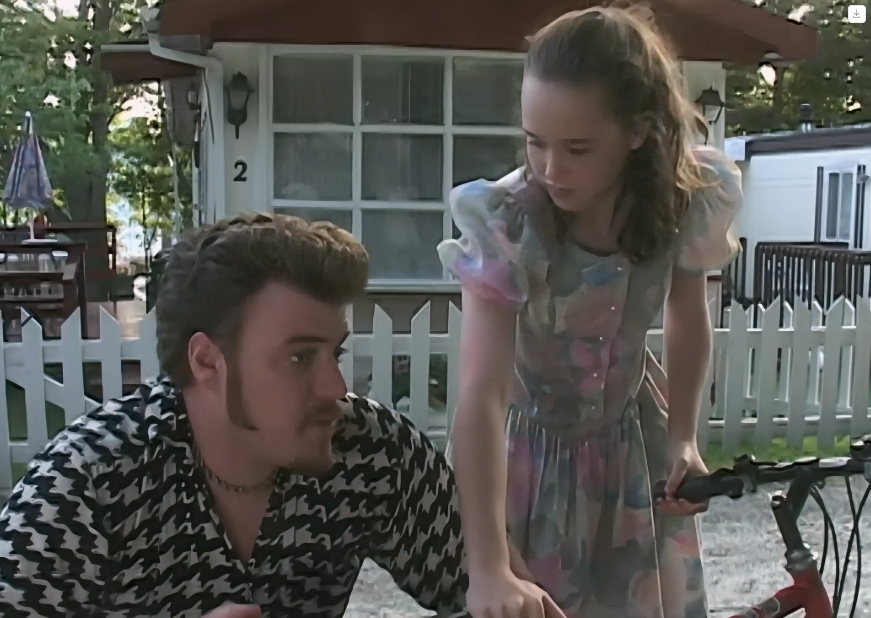
      Elliot Page as Treena Lahey with Ricky in a scene from Trailer Park Boys Season 2, 2002

      Ricky told Treena to leave and somehow meant it kindly.

      When the boys were deep into the Freedom 35 operation, he sat her down and told her she couldn’t be around anymore – things were getting too dangerous, and whatever was coming, she didn’t need to be anywhere near the middle of it. She didn’t take it well.

      Rejection is rejection, even when it’s dressed up as concern. T’was just a guy fumbling through something he didn’t have the vocabulary for. But buried in that graceless delivery was something Ricky rarely managed: actually putting someone else’s safety ahead of his own wants, not as a tactic, not by accident, but as a real choice. He couldn’t have explained it that way if you asked him. He would’ve gotten something wrong by the second sentence. Still, the impulse was genuine – and for Ricky, that’s not nothing.

      Of course, this being Trailer Park Boys, the sweetness had an expiration date. In the Season 2 finale, “The Bare Pimp Project,” Treena runs off with Ricky and Julian’s cash, locking it in a locker with Bubbles’ help so they’d have it when they got out of jail. It was the perfect Sunnyvale ending for the character – she learned the local customs a little too well.

      Why Treena Never Returned

      Season 2 was the beginning and the end of Treena Lahey. When Ricky and Julian return in Season 3, she’s gone. Jim Lahey mentions her once in Season 4 when he proposes to Barb, but otherwise, the character vanishes from the canon. A shame, but it’s probably best left as a brief moment in time considering what happened next for the young actor.

      There are deleted scenes from Season 1 featuring Page, but they were cut and contradict the Season 2 storyline (where Treena clearly doesn’t know Ricky and Julian yet). So Season 2 is the definitive run.

      Why didn’t she come back? The show never explains it on screen. In the Swearnet behind-the-scenes podcasts, they mention she just stopped visiting. The real reason is likely much simpler: Page’s career was taking off. By 2004, they were starring in ReGenesis and winning Gemini Awards. By 2005, Hard Candy hit (seriously, SO good in that one), and the indie film world took notice. Sunnyvale was in the filthy rearview mirror.

      From Sunnyvale to the Academy Awards

      Looking back at those five episodes now is fascinating. You can see the raw talent there. The show was basically filmed on a camcorder by a crew figuring it out as they went, and Page fit right into that documentary-style naturalism.

      Buying pepperoni for Ricky and landing an Oscar nomination for Best Actress in Juno are about as far apart as two things can get. Roger Ebert called it out – nobody had a better performance that year than Page.

      We wrote about Page way back in 2006 when Hard Candy came out, noting the Treena Lahey connection even then. But looking at it now, with everything Page has accomplished since – from Inception to coming out as a trans man in 2020 and landing the cover of Time magazine – that summer in the trailer park feels even more surreal.

      It’s just a cool piece of history. A kid from Halifax who would go on to change Hollywood, spending a few weeks riding a bike around a fictional trailer park, trying to keep Jim Lahey sober and Ricky out of trouble. Happy faakin’ Canada Day, buds.

      Elliot Page Trailer Park Boys – FAQ

      1. Was Elliot Page in Trailer Park Boys?

      Yes. Elliot Page played the character Treena Lahey in Season 2 of Trailer Park Boys, which aired in 2002. Page appeared in five episodes of the season.

      2. Who did Elliot Page play in Trailer Park Boys?

      Page played Treena “T” Lahey, the daughter of Trailer Park Supervisor Jim Lahey and his estranged wife Barb. The character visited the park for the summer and befriended Ricky.

      3. What season of Trailer Park Boys is Elliot Page in?

      Page only appears in Season 2. There were reportedly deleted scenes filmed for Season 1, but they were cut and are not considered part of the show’s canon. Treena does not appear in Season 3 or any subsequent seasons.

      4. How old was Elliot Page in Trailer Park Boys?

      Page was born in February 1987 and the season filmed and aired in 2002, making the actor approximately 14 or 15 years old during their time on the show.

      5. Why did Treena Lahey leave Trailer Park Boys?

      The show never explicitly explains Treena’s absence after Season 2, other than a brief mention that she stopped visiting for the summer. In reality, Page’s acting career was accelerating rapidly with roles in films like Marion Bridge and the series ReGenesis, leading to their international breakthrough in Hard Candy (2005) and Juno (2007).

      Jim Lahey and Treena Lahey played by Elliot Page in Trailer Park Boys Season 2

      A Long Way From Sunnyvale

      We talk a lot about the legacy of this show. We talk about the Steve French episode, the Rickyisms, the sheer staying power of a low-budget Canadian comedy. But the fact that it served as an early training ground for one of the most significant actors of their generation is a detail that deserves more attention. It proves that talent shows up everywhere. Even at a cheeseburger picnic.

      { 0 Comments }

      Tears in Snow: Blade Runner 2049 Honors a Remarkable Vision

      by admin on June 4, 2026
      in Movies, Nerdery, Reminiscent

      Updated on 6/4/26: In Denis Villeneuve’s Blade Runner 2049, the recurring motif of snow serves as a profound thematic counterpoint to the relentless rain of Ridley Scott’s original 1982 film. While the original culminated in Roy Batty’s iconic ‘tears in rain’ monologue, Officer K’s journey ends with tears in snow. This analysis, originally published in August, 2017, explores the meaning of snow in Blade Runner 2049, examining how weather symbolism, Dr. Ana Stelline’s memory creation, and the physical sensation of touch define humanity for replicants and holograms alike.

      Table of Contents

      • “Because you’ve never seen a miracle”
      • “Memories. You’re talking about memories”
      • “Everything you want to see…”
      • “Everything you want to hear…”
      • “Everything you want to be…”
      • “I want to see a negative before I provide you with a positive”
      • “Many is the night I dream of cheese”
      • What does snow symbolize in Blade Runner 2049?
      • Why does Blade Runner 2049 end in snow?
      • Does K die at the end of Blade Runner 2049?
      • What is the Treasure Island reference in Blade Runner 2049?
      • What is the “tears in rain” monologue in Blade Runner?
      • Is Blade Runner 2049 worth watching if you haven’t seen the original?

      When Deckard finally surfaces in Blade Runner 2049 – living alone in the ruins of a Las Vegas casino, cut off from everything he once was – his opening line to K is a quote from Robert Louis Stevenson’s Treasure Island.

      “You mightn’t happen to have a piece of cheese about you, now? Would you, boy?” It’s the line spoken by Ben Gunn, a sailor who has been marooned on a deserted island for three years and has been dreaming of cheese the entire time.

      Villeneuve didn’t put that line there by accident. Deckard is Ben Gunn – isolated, half-mad, dreaming of something he can’t have. K recognizes the quote. “Treasure Island?” he asks. Deckard says: “He reads, that’s good.” It’s a throwaway exchange that tells you everything about both of them in six seconds.

      Given the pop-culture gravitas of this film, there are hundreds of sites on which to find a Blade Runner 2049 synopsis, cast list or trailer. Google is your friend and I have lots of ground to cover. If you’re a fan of 1982’s both revered and oft-underestimated Blade Runner, however, this review is for you.

      “Because you’ve never seen a miracle”

      sapper

      Actually, Sapper, I think I just did. At a theater near Fenway Park, no less. To write an objective review about the unlikely and ridiculously far removed sequel to your favorite movie of all time, 3.5 decades later, is a fool’s errand on the brightest of dystopic Los Angeles days. While I’m quite sure he eventually got paid, Director Denis Villeneuve’s obvious labor of love has made it almost too easy for me to extoll the virtues (and maybe a disappointment or two) of Blade Runner 2049. Short version: This is a fantastic film, for which you do not need a deep knowledge of the original to enjoy. Get a sitter. Go see it. And now, for the long version…

      “Memories. You’re talking about memories”

      Walking out of Monday’s press screening in Boston, I was unprepared for the clipboard-toting PR person waiting for me outside. “What did you think?” she asked. “F*cking awesome!” with two physical thumbs up, was my unrehearsed and regrettable blurt. Not especially quotable, but she recorded it anyway while appearing happy and (maybe) just slightly relieved. That was my first review. Replying “Yes!” when asked today if I wanted to see it again this weekend was my second. What follows is my third. First, though, a nostalgic vignette to set the stage:

      INTERIOR – VW BUG – NIGHT – Summer, 1982:  Somewhere in French-speaking Canada, a 9-year-old boy and his father pull in to a dimly lit, backwoods drive-in. The elder, who has previously refused to let his son read a weathered nightstand copy of Philip K. Dick’s source novel (because it’s too violent, David) hooks a speaker onto the red VW Bug’s half-rolled down driver’s side window and settles in for 164 minutes of the film his offspring will keep embarrassingly front of mind for the next 35 years. On the journey back to the summer cottage where absolutely nobody speaks French, and riding a recounted tide of rusty nails shoved through hands, eyeballs crushed by thumbs and women executed on the street for no reason apparent to the passerby – permission to read “Do Androids Dream of Electric Sheep” is begrudgingly given.

      We will come back to Quebec later (spoiler).

      joi-billboard

      “Everything you want to see…”

      At two key points during the movie, Gosling’s “Officer K” encounters billboards which repeat revenue-inducing quips related to what consumers want to “see”, “hear” and “be”. They also look a lot like the beloved and advanced Amazon Echo back at his apartment. It’s deeper than that, I assure you, but here be no spoilers.

      Right before the screening in Boston began, a studio PR rep had to read out a message from Denis V. himself. The respectful jist was, “It’s tough to review movies, and I get that, just please don’t ruin the film for everyone else. Zut alors!” While I’m paraphrasing, the lockdown and security surrounding key plot points, I was told, is like nothing anyone in the press corps have seen to date.

      What is everything we want to see then? 2049 blows the Blade Runner world straight out – in all directions. Other than the legendary original opening sequence, with L.A.’s towers of fire spouting off whilst accompanied by Vangelis’ intoxicating first notes, and apart from an establishing shot of a Spinner landing or two, there’s precious little shown that isn’t closed-set-sound-stage claustrophobic. The sequel shows us oceans, and deserts, and snow – effectively bringing forward the larger world we’d all imagined as kids (or maybe that was just me). Regardless, it is simply gorgeous.

      2049 also takes CGI to new levels, particularly apparent towards the end where insufferable long-time fans will see something that may simultaneously induce laughter, sobbing… and possibly sharting. Bring towelettes – you’ve been warned. It’s that heavy.

      We also see that the technology in Blade Runner’s universe has evolved since the first film, not surprisingly, as 35 years have passed. Where Deckard once used commands like “stop”, “enhance” and “track right” to investigate Leon’s photographs – we now see the main replicant baddy, (not to be confused with Batty) “Luv”, using those same commands to direct artillery fire. Garbage trucks hover efficiently while sorting filth, smartphones now have a convenient Voight-Kampff app, the Runners get a crazy test called “Baseline” after every shift, Spinners can now dogfight… I should stop there.

      luv-wright

      “Everything you want to hear…”

      A reviewer, whose name I struggle to recall, once referred to the soundtrack of 2008’s There Will be Blood as an “additional character in the film.” Throughout that monumental movie, the music never, ever, ends until the last second of the final credits. It was tailored to the story like nothing we’d ever seen before.

      2049’s score is almost as equally engulfing and tailored. Hans Zimmer picked up the heavy task of scoring the film, in Vangelis’ brilliant Grecian shadow, after Johann Johannsson left the project. This left many clammy-handed BR devotees up in arms, but the result was worth the nerdy turmoil. Most noteworthy are the deep (very deep) notes used in transitional shots while Spinners are flying past. This happens a few times, and after the first instance I was immediately hoping there’d be another location change so I could feel that rush one more time.

      The better news is, Vangelis’ original score is strategically woven in at key moments, and the final scene sees Zimmer’s work completely stripped away in favor of those hot, hot bars from 1982 many of us know so well. Like the hovering Spinner barking orders at Officer K, that unmistakable noise an old Tyrell Corp terminal makes while booting up, voiceovers recounting the mystery’s clues during flight time, heavy leather overcoats and whiskey – 2049’s soundscape glances over its shoulder several times to acknowledge its older sibling. There are more examples. Many more. But, you know… spoilers.

      “Everything you want to be…”

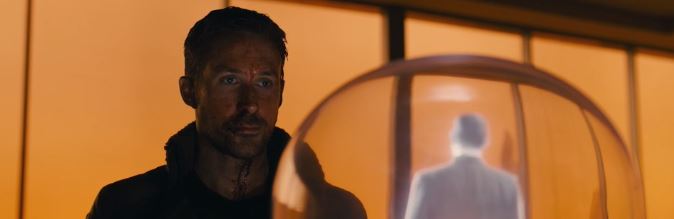
      The humans in 2049 know their history. The replicants only hope they do. The conundrum of implanted memories is a major theme carried over from the original. Only now, Officer K has access to historical replicant POV recordings – dampening the disbelief required to connect the two flicks and still sleep at night. Callbacks to human history which the characters must be aware of are in no short supply. Baby Goose’s (Gosling, anyone?) cell phone links to a lovely 2049 version of an Amazon Alexa back at home, named “Joi”, and plays the opening strands of “Peter and the Wolf” each time it rings. Took me a while to place the tune, and after more time passes I’m sure I’ll appreciate the reference. Hasn’t occurred to me just yet (So… if Luv is the wolf, does that make Deckard and K the sheep? Are the resistance the larger flock? Are all of the sheep androids?) Enough. Joi is the love of K’s life, one lost manufactured soul protecting another, and her presence in the film provides what little insight we get into K’s character.

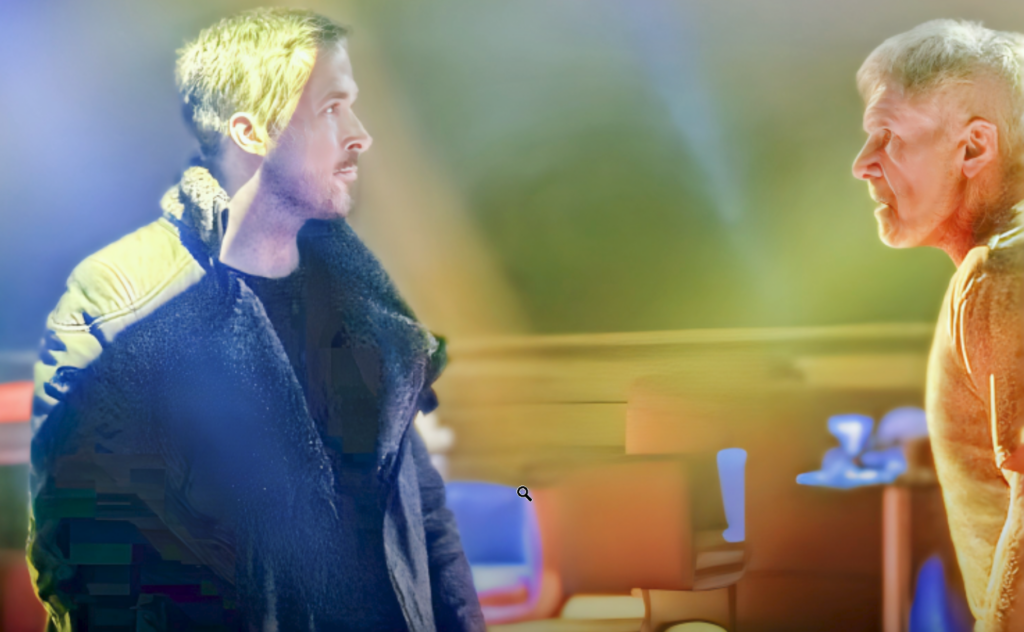
      We all saw Sinatra’s hologram in the second trailer, and should also know by now that Deckard is hiding out in Las Vegas. A favorite scene of mine involves Baby Goose and Ford trading blows while the ghost of Deckard’s casino plays intermittent holograms of the strip’s past in the background. “You know what BR2 needs? More Liberace!” Another thoroughly enjoyable clue that the past is still present in this crazy world.

      Also noticeable is a nod to Treasure Island, but far more fascinating are two (that I counted) subtle references to the story of Pinocchio. At one intimate point, Joi informs Officer K that, “A real boy needs a real name”. No accidental dialogue there, and I guess that makes Jared Leto’s Niander Wallace… Gepetto? Pinocchio allegories have been thrown around in BR forum threads for years, and now there’s a direct reference. Only instead of strings, replicants have a 4-year life span. Anyone?

      “I want to see a negative before I provide you with a positive”

      At the risk of otherwise coming off as a garden-variety fan boy, It must be said – I did take issue in one  respect. While Sylvia Hoek’s “Luv” is more menacing than I ever thought the actor was capable of – in the narrative she’s just an agent. A stooge driven only by Niander Wallace’s orders. She knows what she is, and couldn’t care less.

      You’ll find yourself longing for the tortured warrior-poet, Roy Batty, regardless of whether or not you wanted him or Deckard to prevail on that rainy rooftop in 1982. If this movie needed anything, and that is an admitted stretch because it’s simply a sci-fi milestone, it would be “better-developed and scarier villains”.

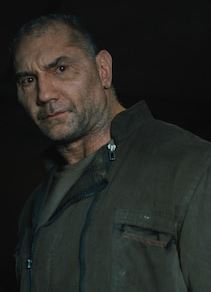
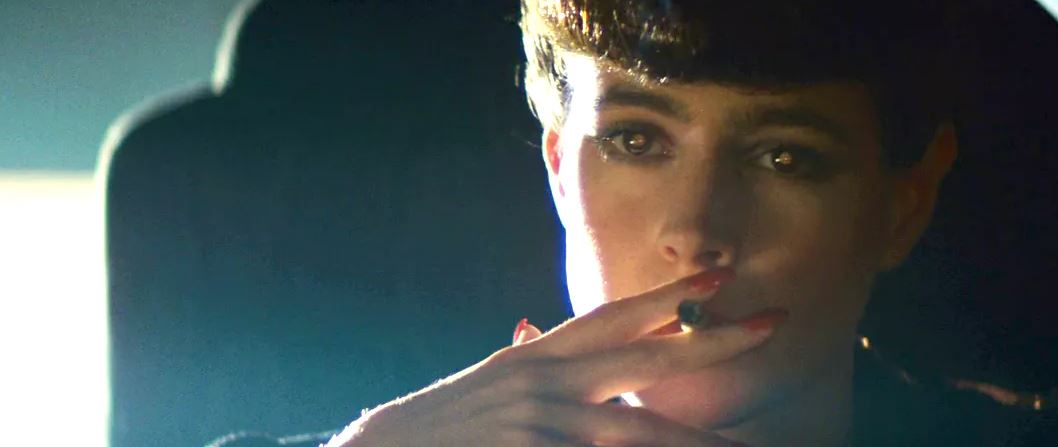
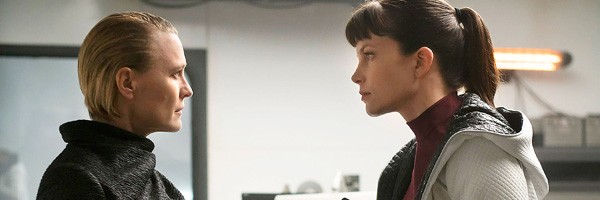
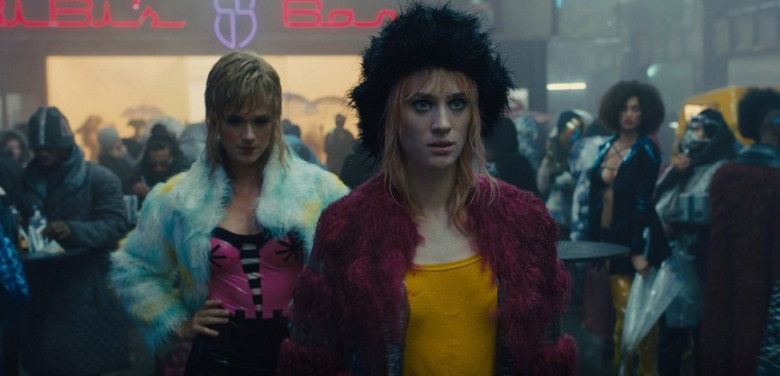
      I have just one more gripe, related to casting. Now, the lineup is almost impeccable: Olmos, Bautista, Wright, Baby Goose, Abdi, Hoeks, Leto, etc. My dismay is due to the underuse of one Mackenzie Davis. When charging through the crowd in that first trailer – she was terrifying. I’d hoped she’d turn out to be at least the equivalent of “Pris” from the original. Similar style, similar hair, similar foreboding sense of “would she date me?” Ultimately, she is almost tragically absent for the rest of the movie, bar one fleeting group shot and a virtual sex scene for the ages.

      “Many is the night I dream of cheese”

      It’s great fun to imagine that, while my 9-year old adolescent pea-brain was being rocked for all time by Ridley Scott in a shoddy Quebec drive-in, a 15-yr old Villeneuve may have been right close by. It’s a sizeable province, but let me have my moment. Maybe he was just one town over, equally as impressed, but with a destiny tied directly to Blade Runner’s unique and astounding universe.

      The Godfather did it, as did Jaws and Aliens. Specifically, those franchises saw an eventual sequel which surpassed, or at least lived up to, the original. Blade Runner 2049 will likely be remembered as a sci-fi classic, and I could not be more relieved. In closing: Denis, nous sommes fiers de vous.

      What does snow symbolize in Blade Runner 2049?

      The weather in Denis Villeneuve’s universe isn’t set dressing. It’s a thematic anchor. In Ridley Scott’s 1982 original, relentless acid rain washed away the artificial tears of dying replicants. By 2049, the climate has collapsed further into toxic snowfall – but the meaning of snow in Blade Runner 2049 shifts from environmental decay to something more personal. A question of authenticity.

      To feel the cold bite of snow on your skin is to experience the physical world. It’s the test of what’s real.

      CharacterInteraction with SnowWhat It Means
      Officer KSnow melts on his hand as he dies on the steps.He’s synthetic, but his experience of the world is genuine. The snow doesn’t pass through him.
      JoiHolographic snowflakes hesitate on her skin, then pass through.She wants connection. She can’t have it. Her upgrade gives her a partial field – not a body.
      Dr. Ana StellineCreates synthetic snow memories inside a sterile lab.The only “real” born child is entirely cut off from the physical world she recreates.

      Irony: The synthetic replicant bleeds out in real snow. The human child manufactures fake snow from behind glass. Villeneuve doesn’t tell you which one is more “alive” – he just puts them side by side and lets you sit with it.

      On my second watch – and the third, and the fourth – the snow symbolism in Blade Runner 2049 becomes impossible to unsee.

      Tears in rain vs. tears in snow

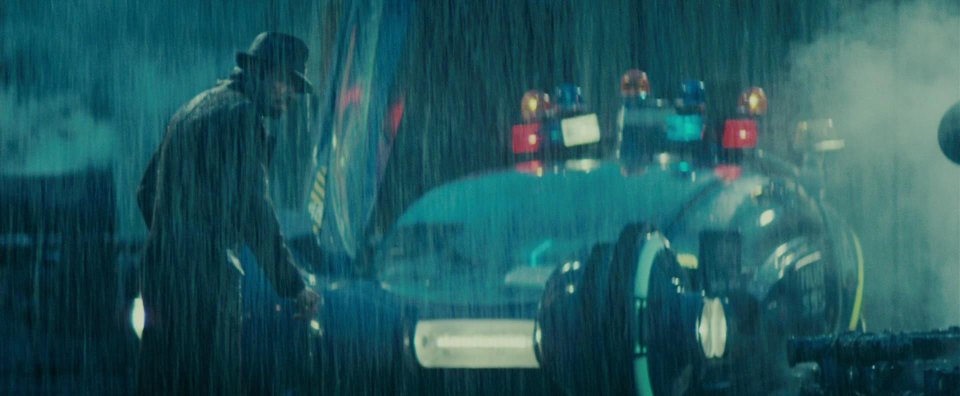
      Roy Batty died on a rainy rooftop in 1982. Officer K bleeds out on snowy steps in 2049.

      The parallel is not subtle. Villeneuve wants you to see it.

      But the two deaths couldn’t be more different in meaning. Batty fought for more life. He crushed skulls and shoved nails through hands to get it. His “tears in rain” monologue – those 42 words Rutger Hauer partially improvised on set – was a lament for experiences that would be lost. Attack ships on fire off the shoulder of Orion. C-beams glittering in the dark near the Tannhäuser Gate. All gone.

      K takes the opposite path. He stops fighting for his own survival. He sacrifices himself so a father can meet his daughter for the first time. When K looks up at the falling snow, he’s not lamenting lost time. He’s accepting his choice.

      Batty died a machine grasping for humanity. K dies a man who already found it.

      And the musical cue Zimmer plays as K lies back on those steps? It’s “Tears in the Rain” from the original Vangelis score. Not a coincidence. Not even close. The blade runner snow ending is the direct spiritual successor to the rain ending – same emotional weight, different weather, different conclusion about what it means to be alive.

      Does K die at the end of Blade Runner 2049?

      Yes. For fuck’s sake. YES.

      Officer K dies in the snow - Blade Runner 2049 ending scene

      K dies on the snowy steps outside the Stelline facility. He took a knife wound to the abdomen during his fight with Luv in the ocean. He was bleeding out the entire time he walked Deckard to the door. He knew it. Deckard probably knew it too.

      Blade Runner 2049 FAQ

      What does snow symbolize in Blade Runner 2049?

      Snow in Blade Runner 2049 represents the physical sensation of being real. Where Ridley Scott used acid rain as an indifferent backdrop to Roy Batty’s death, Villeneuve uses snow as a test of authenticity. Officer K feels it melt on his hand as he dies. Joi’s holographic snowflakes pass through her. Dr. Ana Stelline manufactures it from behind glass. The snow doesn’t lie about what you are.

      Why does Blade Runner 2049 end in snow?

      Officer K’s death in the snow is a direct visual callback to Roy Batty dying in the rain in 1982. Villeneuve designed the parallel intentionally – same visual grammar, different emotional conclusion. Batty died grasping for more life. K dies having chosen to give his up for someone else. The snow is the punctuation on that distinction, and Zimmer’s use of the original Vangelis “Tears in the Rain” cue over the scene makes the connection explicit.

      Does K die at the end of Blade Runner 2049?

      Yes. K dies on the snowy steps outside the Stelline facility from a knife wound sustained during his fight with Luv. He was bleeding out the entire time he walked Deckard to the door. The film doesn’t show his eyes close, but Villeneuve has confirmed in interviews that K’s story ends there. His death is framed not as a tragedy but as a choice – the thing that, more than any implanted memory, makes him real.

      What is the Treasure Island reference in Blade Runner 2049?

      When Deckard first encounters K in his Las Vegas hideout, he greets him with a line from Robert Louis Stevenson’s Treasure Island: “You mightn’t happen to have a piece of cheese about you, now? Would you, boy?” It’s spoken by Ben Gunn, a sailor marooned alone on an island for three years, dreaming of cheese. Villeneuve uses it to signal that Deckard, like Ben Gunn, has been living in isolation so long he’s half-mad with longing. K recognizes the quote. Deckard says: “He reads, that’s good.”

      What is the “tears in rain” monologue in Blade Runner?

      The “tears in rain” monologue is Roy Batty’s final speech in the 1982 original, delivered on a rainy rooftop moments before his death. The most famous lines – “All those moments will be lost in time, like tears in rain” – were partially improvised by Rutger Hauer on set. It is widely considered one of the greatest death scenes in cinema history, and Blade Runner 2049’s snow ending is its direct spiritual successor.

      Is Blade Runner 2049 worth watching if you haven’t seen the original?

      Yes. Villeneuve designed it to function as a standalone film and the world-building is self-contained. That said, the emotional weight of the snow ending, the Vangelis callback, and the significance of Deckard’s return all land considerably harder if you know the original. Watching the 1982 film first is not a hardship.

      The film doesn’t show his eyes close. It doesn’t need to. The Vangelis callback, the snow accumulating on his coat, the stillness – it’s the same visual grammar as Batty’s death. Villeneuve confirmed in interviews that K’s story ends there.

      But his death isn’t a tragedy. K chose this. He chose to protect the secret of Deckard’s daughter. He chose to die for something bigger than his own survival. That choice – more than any implanted memory of a wooden horse, more than any baseline test result – makes him real.

      { 0 Comments }

      A Mountain Lion Named Steve French

      by admin on June 4, 2026
      in Television

      Updated on 6/4/26: Originally published on September 16th, 2004 – shortly after the episode first aired.

      Steve French is the dope-addicted mountain lion from Trailer Park Boys Season 4, Episode 6, “If You Love Something, Set It Free.” For fans of the Canadian mockumentary, this 2004 episode stands as a series high-water mark. It perfectly balances Sunnyvale’s signature absurdity – like Trevor getting assaulted by a cougar high on Viagra burgers – with genuine, earned emotion from Bubbles. DavePye.com breaks down why this specific episode remains a cult favorite, the behind-the-scenes reality of filming with live predators, and why three grown men crying in the woods over a wild animal is the purest distillation of the show’s heart.

      Table of Contents

      • The Legacy of Sunnyvale’s Biggest Kitty
      • What Steve French Reveals About Bubbles
      • The Lahey “Shit Abyss” Connection
      • The Accidental Genius of the J-Roc Subplot
      • The Best Rickyisms of the Episode
      • Behind the Scenes: The Real Steve French
      • The Animated Return of Steve French
      • From the DavePye.com Archives: September 2004
      • Frequently Asked Questions

      Three grown men crying in the woods over a mountain lion they’ve known for 72 hours. That’s the thing nobody expects from a show about petty criminals in a Nova Scotia, Canada trailer park. The almighty Sunnyvale.

      The Legacy of Sunnyvale’s Biggest Kitty

      When you ask a hardcore fan to name the best episode of the series, “If You Love Something, Set It Free” is almost always in the top three. Personally, I’d add “Closer to the Heart” and absolutely “Who’s the Microphone Assassin?” to the list.

      Steve French’s introduction to the popular culture pantheon currently holds an 8.5/10 rating on IMDB, and publications like CinemaBlend consistently rank it among the show’s absolute best. It’s the episode that defines exactly what the show does better than any other comedy on television: it takes a premise that sounds like a drunken fever dream and grounds it in absolute sincerity.

      Season 4 is widely considered the peak of the series. The boys are out of jail, the schemes are intricate, and the character dynamics are fully locked in. But this episode is the emotional anchor of the season.

      The setup is pure Sunnyvale. Something is eating Ricky’s dope crop. Bubbles assumes it’s a “Samsquantch,” but it turns out to be a full-grown mountain lion. Naturally, Bubbles doesn’t call animal control. He slaps a choker chain on a 150-pound apex predator, names him “Steve French” – noting the cougar’s markings look like a French Canadian mustache – and decides to wean him off the marijuana.

      What follows is twenty-two minutes of chaos. Steve French wanders the park. He eats Randy’s Viagra-laced burgers (intended for Jim Lahey). He develops an inappropriate attraction to Trevor’s leopard-print jacket. But the jokes aren’t why the episode is remembered. It’s remembered for the ending.

      What Steve French Reveals About Bubbles

      Bubbles’ relationship with cats is the longest-running gag on the show. But Steve French is where the gag becomes something real. Bubbles doesn’t just like cats (he also likes liquor and whores). He sees something in them – a kind of uncomplicated loyalty that the rest of his chaotic life can’t offer. When he looks at a mountain lion and sees a “big kitty” who needs help, that’s not stupidity. That’s Bubbles being exactly who he is.

      The brilliance of the episode is how it forces the rest of the cast to meet Bubbles on his level. Julian’s instinct is to get rid of the lion immediately. Julian always sees the angle and the risk. Ricky’s instinct is to panic.

      Yet, in the final scene, all three men are standing in the woods, crying as they release Steve French back into the wild. They aren’t mocking Bubbles. They’re mourning with him. That’s the show at its best – characters who are fundamentally self-interested, getting pulled into genuine emotion by their friend’s sincerity.

      The Lahey “Shit Abyss” Connection

      There’s a subtle layer to this episode that often goes unnoticed. It features one of Jim Lahey’s most famous liquor-fueled rants. Staring down Ricky, Lahey slurs out: “He who looks into the abyss realizes that there’s nothing looking back at him, and the only thing he sees is his own character, Ricky. You understand? Bud? The Abyss? The shit-abyss.”

      It’s a direct bastardization of Friedrich Nietzsche’s famous quote: “And if you gaze long into an abyss, the abyss also gazes into you.”

      Lahey twisting 19th-century German philosophy into a drunken threat about trailer park politics is the kind of high-low comedy that makes the show brilliant. It elevates the character from a simple drunk to a tragic, over-educated figure trapped in his own failures. Most sitcoms would be content with the physical comedy of Lahey falling over. Trailer Park Boys gives him a Nietzsche reference.

      The Accidental Genius of the J-Roc Subplot

      The episode also features one of the most elegant pieces of plotting in the entire series. J-Roc is supposed to be in jail, which gives him immense street cred. In reality, he got a light sentence of community service and has been hiding under his mom’s trailer so his manager, DVS, doesn’t find out he’s not actually doing hard time.

      The boys decide the best place to hide Steve French from Lahey is under J-Roc’s trailer. When they shove the mountain lion under the skirting, a terrified J-Roc scrambles out, completely blowing his cover.

      It’s a masterclass in sitcom writing. A mountain lion accidentally solves a completely unrelated problem just by existing. It ties the A-plot and the B-plot together without forcing the characters to act out of character.

      The Best Rickyisms of the Episode

      You can’t talk about a classic episode without looking at the Rickyisms. “If You Love Something, Set It Free” delivers two of the best in the series.

      When trying to figure out what’s wrong with the mountain lion, Ricky panics and asks: “What if he has radies?” It’s a perfect Rickyism – he knows the word rabies exists, he knows it’s associated with wild animals, but his brain just slightly misfires on the delivery.

      Later, when comforting Bubbles about releasing the cat, Ricky attempts to use the episode’s titular proverb: “If he comes back, it forever was, just like the saying.” It’s completely mangled, but the intent is so genuinely sweet that it works anyway.

      Behind the Scenes: The Real Steve French

      Filming the episode was considerably more dangerous than it looked on screen. Steve French was actually played by two real, trained cougars named Stoney and Sophie, provided by Creative Animal Talent.

      According to Mike Smith (who plays Bubbles), working with the big cats was terrifying. During an appearance on the Roach Approach podcast, Smith revealed that he had some incredibly close calls on set. At one point, one of the cougars reportedly lunged at him, and he was only saved by the handler intervening at the last possible second.

      When you watch the episode knowing that Smith was inches away from an actual, unpredictable predator, Bubbles’ nervous energy in those scenes takes on a whole new context. The fear in his eyes wasn’t entirely acting. I wonder how frightening he found Elliot / Ellen Page during her brief stint in Season 1?

      The Animated Return of Steve French

      For years, fans wondered if Steve French would ever make a comeback. The show answered that question in 2019, though not in the live-action format. In Season 1, Episode 4 of Trailer Park Boys: The Animated Series (titled “The Penis Milker”), Steve French returns.

      The animated format allows the show to lean fully into the absurdity. Bubbles consumes a massive amount of mushrooms, resulting in a hallucination where Steve French can actually speak to him – complete with a thick French Canadian accent. It’s a surreal callback that honors the original episode and takes advantage of the new format’s lack of physical limitations.

      Frequently Asked Questions

      1. Who Is Steve French in Trailer Park Boys?

      Steve French is a mountain lion who appears in Season 4, Episode 6 of Trailer Park Boys, titled “If You Love Something, Set It Free”. He was discovered eating Ricky’s dope crop and subsequently adopted by Bubbles, who named him after his “French-looking mustache” markings.

      2. What Season and Episode Is Steve French In?

      Steve French appears in Season 4, Episode 6. The episode originally aired on May 16, 2004 on Canadian television.

      3. Was Steve French a Real Mountain Lion?

      Yes. Steve French was played by two real trained cougars named Stoney and Sophie, provided by Creative Animal Talent. Both are credited in the episode’s end credits.

      4. Why Did Bubbles Name the Mountain Lion Steve French?

      Bubbles named the lion Steve French – he thought the markings around the cougar’s mouth looked like a French Canadian mustache.

      5. Did the Mountain Lion Actually Attack Mike Smith (Bubbles)?

      According to Mike Smith, working with the live cougars was extremely dangerous. He has stated in interviews that he had a close call on set where one of the cats lunged at him, requiring the handler to intervene.

      6. Does Steve French Ever Return to the Show?

      Yes, Steve French returns in Season 1, Episode 4 of Trailer Park Boys: The Animated Series. Due to Bubbles hallucinating on mushrooms, Steve French is depicted as being able to speak with a French Canadian accent.

      7. Is the Steve French Episode Considered One of the Best Trailer Park Boys Episodes?

      It’s consistently ranked among the top episodes by fans and critics alike. CinemaBlend ranked it #4 on their all-time list. The combination of physical comedy, the Viagra burger subplot, J-Roc’s street cred exposure, and the genuinely emotional ending makes it a standout in the series.

      The Steve French episode aired in 2004. Twenty-plus years later, people are still naming their cats after a mountain lion who appeared in one episode of a Canadian mockumentary. That’s not a cult following. That’s something that was… a beautiful thing.

      { 8 Comments }
      Next

      Sidebar

      Recent Comments

      • admin on Why the “Implication” is TV History’s Darkest Moment
      • admin on Why the “Implication” is TV History’s Darkest Moment
      • Jason Scott Curless on Why the “Implication” is TV History’s Darkest Moment
      • CelebWikiCorner on Defending Gary Busey
      • Monstah on 80’s Music: My Ultimate Top Ten Bestest Song List.

      Categories

      Copyright © 2026 · Pop Culture Blog: Music, Movie and Humor · All Rights Reserved